Source: Central Bank of the UAE. Read the original report (PDF).
The Central Bank of the UAE (CBUAE) released its Quarterly Economic Review for December 2025, covering Q3 2025 data. I read these reports so founders and operators I work with do not have to wade through 25 pages of central bank language to find what matters for their business decisions. Here is what stood out.
The Headline: UAE GDP Is in Strong Growth Territory
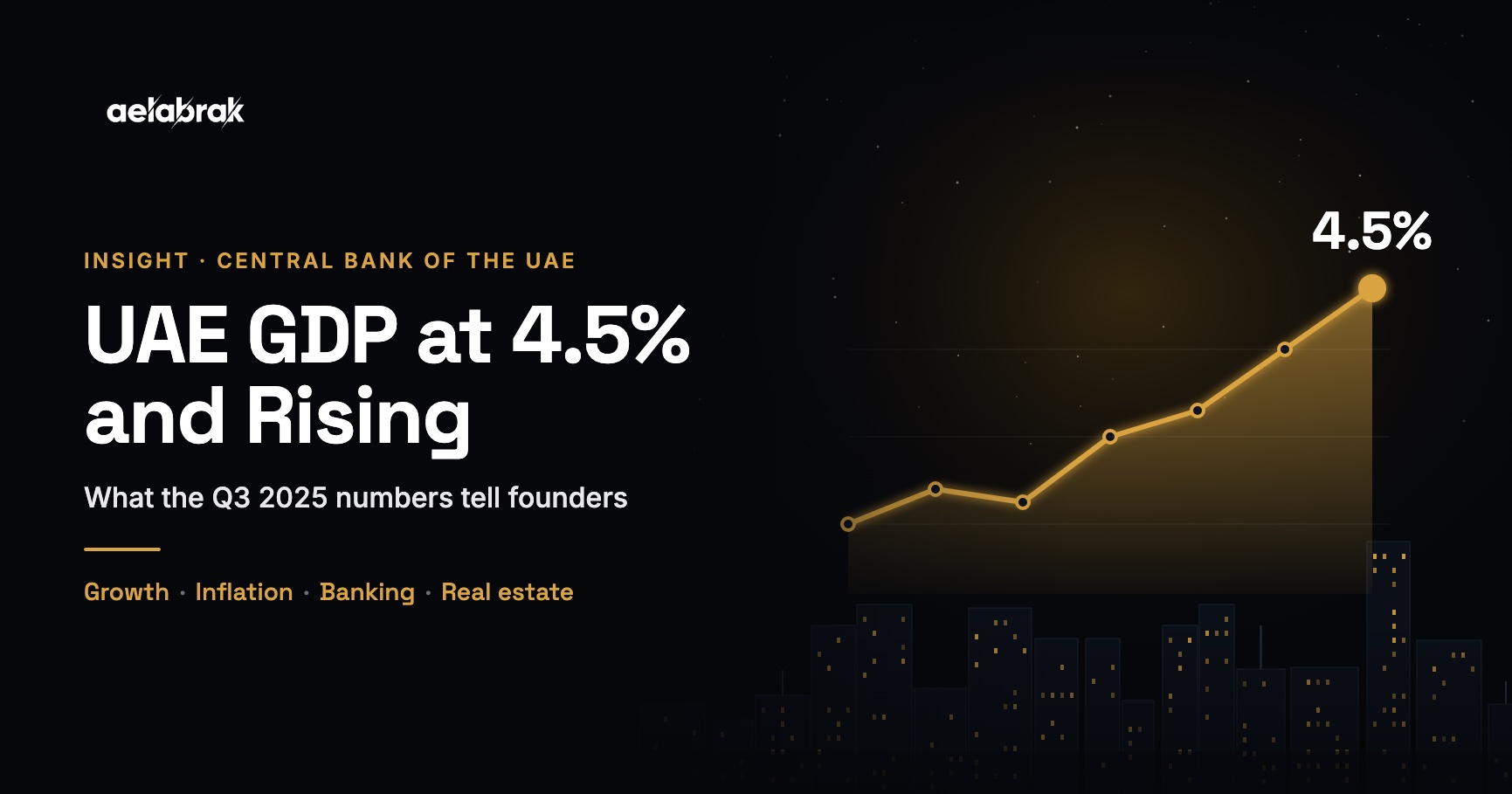
UAE GDP expanded by 4.5% year-on-year in Q2 2025, driven by strong non-hydrocarbon output: particularly in financial and insurance services, manufacturing, and construction. The full-year 2025 GDP growth forecast has been revised to 5.0%, with the non-hydrocarbon sector expanding by 4.9%. In 2026, growth is projected to accelerate to 5.2%, driven by stronger performance across both oil and non-oil sectors.
For context: the global economy is forecast to expand by only 3.2% in 2025 (IMF estimate). The UAE is growing at over 1.5x the global average. That gap matters when you are deciding where to base a business or where to focus commercial activity.
Inflation Is Essentially Contained
UAE inflation stood at just 1.1% in Q3 2025. Energy costs remained in deflationary territory, and food prices continued to ease. The CBUAE revised its full-year 2025 inflation forecast down to 1.3% from a prior estimate of 1.5%. For 2026, inflation is projected to tick slightly upward to 1.8%, primarily base effects from the low 2025 baseline, not structural price pressure.
What this means operationally: the cost environment in the UAE is stable and predictable. Wage and pricing negotiations can be planned with reasonable confidence. This is not a market where inflation is quietly eroding your margins.
The Banking Sector Is in Excellent Shape
Total banking sector assets increased by 18.1% year-on-year to AED 5.2 trillion by the end of Q3 2025. The loan portfolio grew by 14.7% year-on-year and deposits rose by 15.4% year-on-year over the same period. Banks maintained a capital adequacy ratio of 17.4% in Q3 2025, well above international minimums, and the non-performing loan ratio continued its declining trajectory to 1.6%.
A healthy, well-capitalised banking sector matters for businesses for one practical reason: credit availability. When banks are liquid and well-capitalised, commercial lending, trade finance, and corporate banking services flow normally. The UAE banking sector is not a constraint on business activity right now. It is an enabler.
Real Estate and Capital Markets: Both Running Hot
The UAE residential sales market posted double-digit growth rates for the first three quarters of 2025, reflecting continued strong demand primarily driven by apartment sales. Capital markets recorded high growth in Q3 2025, with the Dubai Financial Market share price index increasing by 37.9% year-on-year, and the Abu Dhabi Securities Market General Index rising by 8.7% year-on-year.
Credit default swap spreads for Abu Dhabi and Dubai remained low, a technical indicator that global markets continue to see UAE sovereign and corporate credit as highly credible. For businesses raising capital or structuring financial products with UAE domicile, the market backdrop is as supportive as it has been in years.
The Insurance Sector: A Sign of Commercial Maturity
Gross written premiums in the insurance sector rose by 13.7% year-on-year in Q3 2025, and the number of insurance policies increased by 6.9% year-on-year. This is an underappreciated data point. Insurance growth is a proxy for commercial activity: more businesses, more assets, more risks being formally managed. A 13.7% premium growth rate suggests that the productive commercial base of the UAE is expanding meaningfully.
What This Means If You Are Running a Business in the UAE
The macro environment entering 2026 is genuinely favourable. Strong GDP growth, contained inflation, a well-capitalised banking sector, deep capital markets, and booming real estate. The conditions that made the UAE attractive over the past decade have not deteriorated. If anything, the gap between the UAE and comparable markets has widened.
Three practical implications: first, the cost of doing business is stable. Second, access to banking and financial services is not constrained. Third, if your business serves the real estate sector, the financial services sector, or the broader UAE consumer and corporate market, the demand environment is strong.
The 2026 growth acceleration forecast of 5.2% suggests this is not a market that is peaking. It is a market that is still in an expansion phase. That context should inform commercial decisions around hiring, investment, and market entry timing.
Source: Central Bank of the UAE, Quarterly Economic Review, December 2025. Available at centralbank.ae.
Frequently Asked Questions
What was UAE GDP growth in 2025?
UAE GDP expanded by 4.5% year-on-year in Q2 2025, with the full-year 2025 forecast revised to 5.0%. The non-hydrocarbon sector expanded by 4.9%, driven by financial services, manufacturing, and construction. In 2026, growth is projected to accelerate to 5.2%, according to the Central Bank of the UAE Quarterly Economic Review.
Is UAE inflation a risk for businesses in 2025?
No. UAE inflation stood at just 1.1% in Q3 2025, well below global averages. Energy costs remained in deflationary territory and food prices continued to ease. The CBUAE revised its full-year 2025 inflation forecast down to 1.3%. The cost environment in the UAE is stable and predictable for business planning.
How strong is the UAE banking sector in 2025?
The UAE banking sector is in excellent shape. Total banking assets increased by 18.1% year-on-year to AED 5.2 trillion by Q3 2025. The loan portfolio grew by 14.7%, deposits rose by 15.4%, and the non-performing loan ratio declined to 1.6%. Capital adequacy ratio stands at 17.4%, well above international minimums.
What does UAE GDP growth mean for businesses entering the market?
UAE GDP growing at 5.0% in 2025, over 1.5x the global average, signals a market in active expansion. For businesses evaluating where to base operations or focus commercial activity, the UAE offers a rare combination of strong GDP growth, low inflation, and a well-capitalised banking sector. The 2026 forecast of 5.2% suggests the expansion phase is not peaking.
What sectors are driving UAE non-oil growth?
The primary drivers of UAE non-hydrocarbon growth in 2025 are financial and insurance services, manufacturing, and construction. The insurance sector saw gross written premiums rise by 13.7% year-on-year, a proxy for expanding commercial activity. Real estate recorded double-digit growth rates across the first three quarters of 2025.
Questions I get asked
What was UAE GDP growth in 2025?
UAE GDP expanded by 4.5% year-on-year in Q2 2025, with the full-year 2025 forecast revised to 5.0%. The non-hydrocarbon sector expanded by 4.9%, driven by financial services, manufacturing, and construction. In 2026, growth is projected to accelerate to 5.2%, according to the Central Bank of the UAE Quarterly Economic Review.
Is UAE inflation a risk for businesses in 2025?
No. UAE inflation stood at just 1.1% in Q3 2025, well below global averages. Energy costs remained in deflationary territory and food prices continued to ease. The CBUAE revised its full-year 2025 inflation forecast down to 1.3%. The cost environment in the UAE is stable and predictable for business planning.
How strong is the UAE banking sector in 2025?
The UAE banking sector is in excellent shape. Total banking assets increased by 18.1% year-on-year to AED 5.2 trillion by Q3 2025. The loan portfolio grew by 14.7%, deposits rose by 15.4%, and the non-performing loan ratio declined to 1.6%. Capital adequacy ratio stands at 17.4%, well above international minimums.
What does UAE GDP growth mean for businesses entering the market?
UAE GDP growing at 5.0% in 2025, over 1.5x the global average, signals a market in active expansion. For businesses evaluating where to base operations or focus commercial activity, the UAE offers a rare combination of strong GDP growth, low inflation, and a well-capitalised banking sector. The 2026 forecast of 5.2% suggests the expansion phase is not peaking.
What sectors are driving UAE non-oil growth?
The primary drivers of UAE non-hydrocarbon growth in 2025 are financial and insurance services, manufacturing, and construction. The insurance sector saw gross written premiums rise by 13.7% year-on-year, a proxy for expanding commercial activity. Real estate recorded double-digit growth rates across the first three quarters of 2025.
Get the next reading in your inbox.
Gulf Business Weekly: one short email a week from inside the market. No filler, no pitches.