The Strait of Hormuz has always been a footnote in Gulf expansion plans. Last week, it became a live operational variable.
What Happened
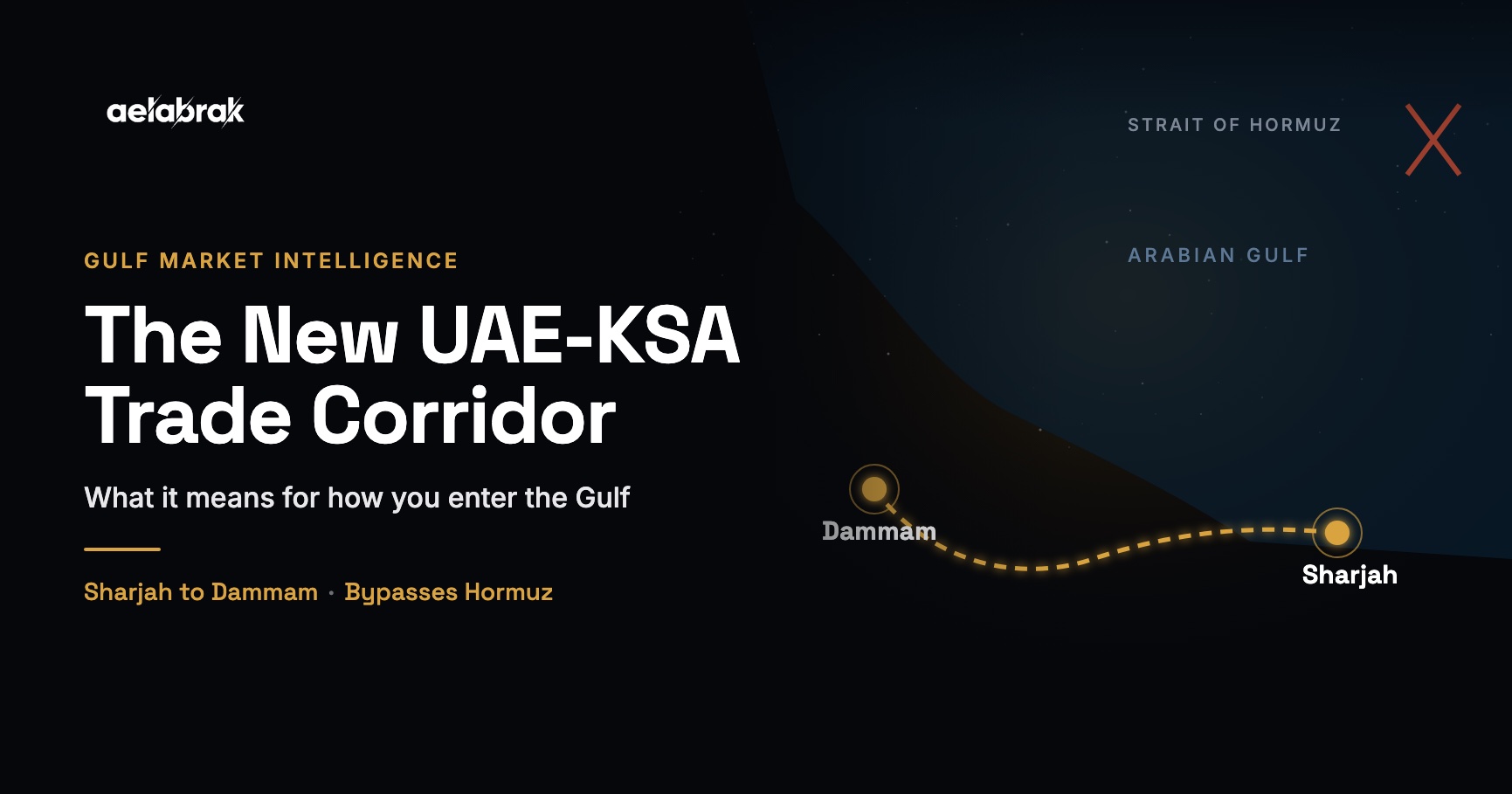
On March 23, 2026, Saudi Ports Authority, Mawani, and Sharjah-based Gulftainer announced a new sea-land corridor connecting Khorfakkan on the UAE east coast to Dammam in Saudi Arabia’s Eastern Province. The route bypasses the strait entirely. Cargo bound for India, Africa, and Australia exits through Khorfakkan into the Indian Ocean. Cargo heading to Europe routes from Dammam. The trigger: ongoing disruption to Hormuz shipping lanes from the Iran conflict.
That is the logistics story. Here is the strategy story.
What This Changes for International Companies
Most Gulf entry plans default to Jebel Ali in Dubai as the logistics entry point. It is the largest container port in the Middle East and the assumption baked into most market entry models. That assumption carries Hormuz dependency. The new corridor changes three calculations.
Three Business Profiles That Need to Re-evaluate
Product and manufacturing companies. If you ship physical goods into the Gulf and your logistics plan defaults to Jebel Ali, you have a documented single point of failure. The Khorfakkan-to-Dammam route is a working bypass. It also changes where you hold inventory. A warehouse base near Khorfakkan or Sharjah’s east coast is now a strategic asset, not just a cost line.
Distribution companies evaluating UAE vs KSA as a base. This corridor connects UAE east coast infrastructure directly to Dammam, putting KSA’s Eastern Province within reach of the same logistics spine. If your distribution model covers both markets, a UAE east coast base now serves both sides. That is a different calculation than the one you were running six months ago.
Any company whose GTM plan assumed Hormuz was stable. If your Gulf entry plan says “we will ship through Dubai” and stops there, add a secondary routing option before your first commercial transaction. This is not theoretical risk management. It is a practical gap in your operational plan.
The Bigger Point
I have been telling international teams for years: UAE and KSA are not two separate markets to enter sequentially. They are one commercial corridor with two regulatory environments. The companies that plan them that way move faster, spend less on duplicated infrastructure, and build partner networks that cover both sides of the border from the start.
This corridor makes that framing literal. A single logistics spine now physically connects both markets, bypassing the strait risk in the process.
I have worked with international teams who set up in Dubai and then spent 18 months trying to serve KSA from there, fighting transit times, customs handoffs, and partner fragmentation. The teams that planned UAE and KSA as one interconnected commercial system from day one consistently outperformed them.
The corridor does not change the regulatory picture. You still need to understand entity structure, licensing, and your entry sequence. But it changes the infrastructure picture, and your entry point decision now reflects both.
What to Do Now
If you are planning Gulf entry in 2026, use the UAE vs KSA Sequencing Readiness Model to pressure-test your current assumptions against this new variable. If you need to map your distribution or channel partner network across both markets, that work needs to start with the corridor in mind.
You can also compare all six GCC markets side by side if you are still deciding where to enter first.
Or talk to me directly on WhatsApp. If you are actively planning Gulf entry this year, 30 minutes of the right conversation saves months of the wrong decisions.
Frequently Asked Questions
What is the new UAE-KSA trade corridor announced in March 2026?
In March 2026, Saudi Ports Authority, Mawani, and Gulftainer (Sharjah) announced a new sea-land logistics corridor connecting Khorfakkan port on the UAE east coast to Dammam in Saudi Arabia’s Eastern Province. It bypasses the Strait of Hormuz, providing an alternative route for cargo moving between the Gulf and global markets including India, Africa, Australia, and Europe.
How does the Hormuz bypass corridor affect Gulf market entry strategy?
The corridor changes the entry point calculation for any company shipping physical goods into the Gulf. Jebel Ali (Dubai) has been the default logistics entry assumption for most market entry plans, but it carries Strait of Hormuz dependency. The Khorfakkan-to-Dammam route provides a working bypass and changes where companies should hold inventory and establish logistics infrastructure.
Should international companies reconsider UAE vs KSA sequencing because of this corridor?
Yes, particularly for product, distribution, and logistics businesses. The corridor connects UAE east coast infrastructure directly to KSA’s Eastern Province, meaning a UAE east coast base can service both markets through a single logistics spine. Companies evaluating where to base their GCC operations should factor in the corridor when assessing their operational reach.
Is UAE still the right first market to enter in 2026?
For most international companies, yes. UAE offers faster setup, more predictable licensing timelines, and a well-developed commercial infrastructure. The more useful framing is to plan UAE and KSA as one commercial corridor from the start. The Sharjah-Dammam corridor reinforces this: the two markets are physically interconnected, and your entity structure, logistics plan, and partner network should reflect that from day one.
How do I decide which Gulf entry point is right for my business?
It depends on your product type, buyer profile, logistics model, and commercial timeline. The UAE vs KSA Sequencing Readiness Model walks through the key dimensions and gives a structured recommendation. For product and distribution businesses, the new corridor adds a logistics layer to the assessment that was not previously a variable.
Anas El-Abrak GTM & Growth Partner, UAE & KSA Absher Business
Questions I get asked
What is the new UAE-KSA trade corridor announced in March 2026?
In March 2026, Saudi Ports Authority, Mawani, and Gulftainer (Sharjah) announced a new sea-land logistics corridor connecting Khorfakkan port on the UAE east coast to Dammam in Saudi Arabia's Eastern Province. It bypasses the Strait of Hormuz, providing an alternative route for cargo moving between the Gulf and global markets including India, Africa, Australia, and Europe.
How does the Hormuz bypass corridor affect Gulf market entry strategy?
The corridor changes the entry point calculation for any company shipping physical goods into the Gulf. Jebel Ali (Dubai) has been the default logistics entry assumption for most market entry plans, but it carries Strait of Hormuz dependency. The Khorfakkan-to-Dammam route provides a working bypass and changes where companies should consider holding inventory and establishing logistics infrastructure.
Should international companies reconsider UAE vs KSA sequencing because of this corridor?
Yes, particularly for product, distribution, and logistics businesses. The corridor connects UAE east coast infrastructure directly to KSA's Eastern Province, meaning a UAE east coast base can now service both markets through a single logistics spine. Companies evaluating where to base their GCC operations should factor in the corridor when assessing operational reach.
Is UAE still the right first market to enter in 2026?
For most international companies, yes. UAE offers faster setup, more predictable licensing timelines, and a well-developed commercial infrastructure. The more useful framing is to plan UAE and KSA as one commercial corridor from the start. The Sharjah-Dammam corridor reinforces this: the two markets are physically interconnected, and your entity structure, logistics plan, and partner network should reflect that from day one.
How do I decide which Gulf entry point is right for my business?
It depends on your product type, buyer profile, logistics model, and commercial timeline. The UAE vs KSA Sequencing Readiness Model at aelabrak.com/tools/uae-ksa-sequencing walks through the key dimensions and gives a structured recommendation. For product and distribution businesses, the new corridor adds a logistics layer to the assessment that was not previously a variable.
Get new articles in your inbox.
Gulf Business Weekly: one short email a week from inside the market. No filler, no pitches.