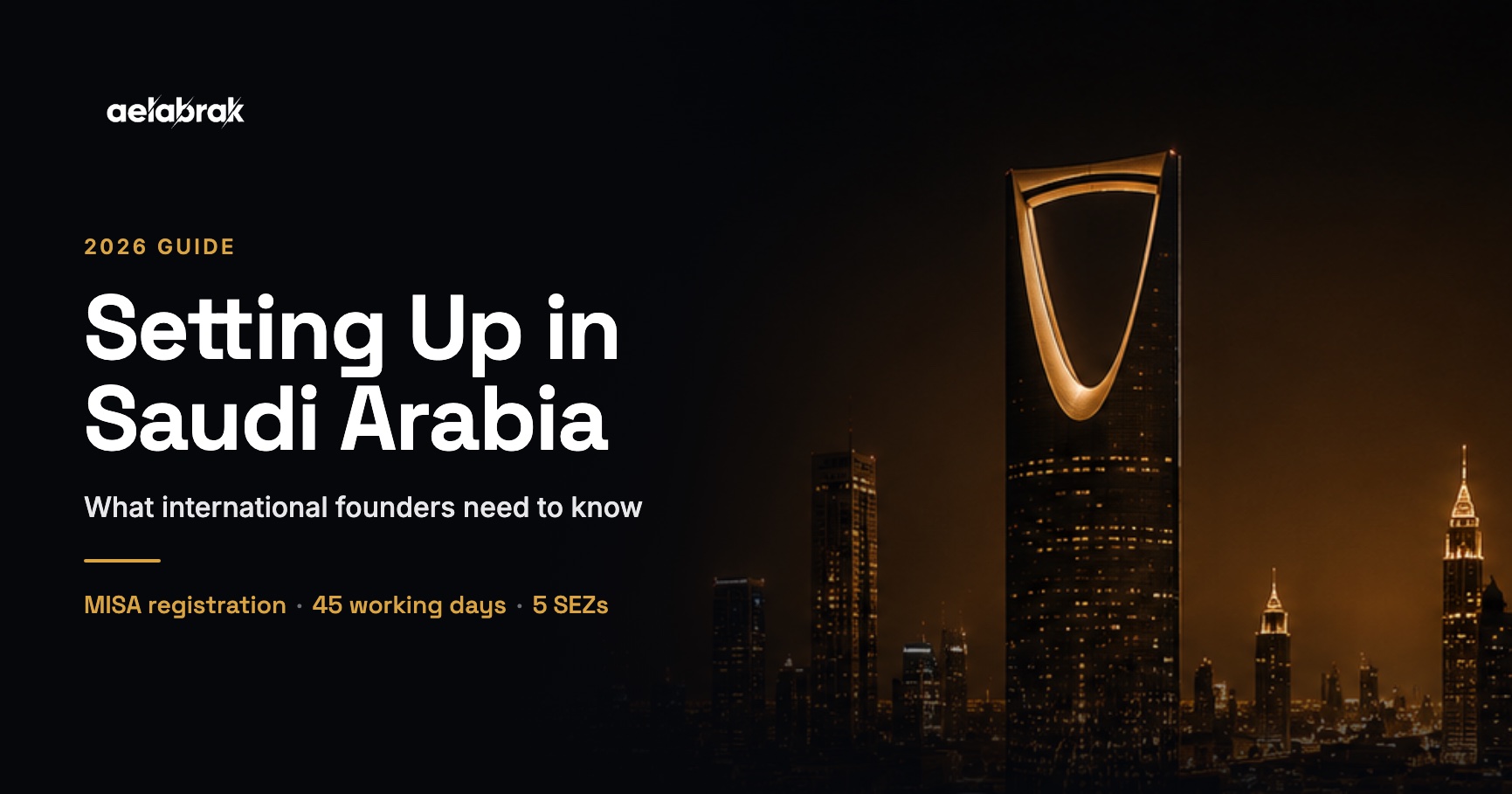
Saudi Arabia stopped being a “maybe later” market for most international founders sometime in the last 18 months. Vision 2030’s giga-projects have moved from announcement to operations, and the rules for foreign companies changed with them. Since the new Investment Law took effect in February 2025, a foreign investor registers an investment with the Ministry of Investment (MISA) instead of applying for a discretionary licence. Here is what that changes if you are setting up in 2026.
MISA Registration Opens the Process. Four More Steps Follow.
Every foreign-owned company still starts with MISA. The official review period is up to 10 working days once the file is complete, but the documentation bar has not dropped: you need proof of the parent company’s standing, usually its latest audited financial statements. The activity you register is the one you will be held to later, so choose it with care. I’ve seen founders register the wrong activity category and spend weeks in correction.
After MISA come the Ministry of Commerce registration, ZATCA for tax, the Chamber of Commerce, and the labour and payroll platforms. Each has its own queue. Done in sequence, the full process takes about 45 working days. That is the timeline I plan for on every KSA formation.
Special Economic Zones Change the Tax Calculation
Saudi Arabia has five Special Economic Zones: the Special Integrated Logistics Zone in Riyadh, King Abdullah Economic City, Ras Al-Khair, Jazan, and the Cloud Computing zone. Jazan, King Abdullah Economic City and Ras Al-Khair offer a 5% corporate income tax rate for up to 20 years plus withholding tax and customs relief. The Riyadh logistics zone has its own terms for qualifying logistics activities. Whether any of them applies depends on your sector and where you will actually operate, so check eligibility before you default to a standard registration.
SASO and GOSI Belong in the Plan From Day One
SASO (Saudi Standards, Metrology and Quality Organization) conformity requirements cover a wider range of goods than most founders expect, including industrial components and some B2B equipment. GOSI, the social insurance scheme, starts with your first employee. Saudi nationals are covered for pension, occupational hazards and unemployment insurance. Expatriate employees are covered for occupational hazards only, at 2% of salary paid by the employer. Founders who plan their KSA entity on the UAE end-of-service model tend to find both gaps at their first compliance review.
The UAE Plus KSA Question
The question I hear most from international founders in 2026 is which of the two comes first, UAE or KSA, and how long the gap between them should be. A UAE entity with a KSA operating entity is workable for many sectors, but the order matters. KSA’s registration process works best when you arrive with one clearly defined activity. A broad commercial licence copied from a UAE template slows it down. Many founders put the UAE first out of habit. Check whether KSA is the larger near-term revenue opportunity for your business before you decide.
Since February 2025, foreign investors in Saudi Arabia register their investment with the Ministry of Investment (MISA) under the new Investment Law, which replaced the old discretionary licence. MISA reviews a complete file within 10 working days, and the full sequence (MISA, Ministry of Commerce, ZATCA, Chamber of Commerce and labour platforms) takes about 45 working days. 100% foreign ownership is available for most commercial and professional services activities without a Special Economic Zone. Saudi Arabia’s five SEZs add incentives such as a 5% corporate income tax rate for up to 20 years in Jazan, King Abdullah Economic City and Ras Al-Khair.
What This Means If You Are Deciding Now
Standard KSA formation costs AED 20,000 to 80,000 depending on activity, capital requirements and SEZ eligibility, in line with the wider Gulf comparison. Timeline matters more than cost: the 45 working days only hold if the activity and the sequence are right from the start.
If you are weighing whether KSA fits into your Gulf entry now, or in what order relative to the UAE, that sequencing decision is where most of the cost and delay gets decided.
For a comparison of Saudi Arabia against the UAE, Qatar and Oman on ownership structure and cost, see 100% Foreign Ownership in the Gulf. For a country-level breakdown of Saudi market entry, see Expand to Saudi Arabia. Or use the UAE vs KSA Sequencing Readiness Model to work through the order that fits your business.
If you are ready to establish a KSA entity, message me on WhatsApp. Business Formation KSA (T2-02) covers MISA registration, the full formation sequence, Saudization planning and post-setup compliance in one engagement. For an example, see how I structured a US consultancy’s UAE and KSA subsidiaries.
Frequently Asked Questions
How long does it take to register a company in Saudi Arabia in 2026?
MISA reviews a complete investment registration file within 10 working days. The full sequence, from MISA through the Ministry of Commerce, ZATCA, the Chamber of Commerce and the labour platforms, takes about 45 working days when done in order with one clearly defined activity.
Do I need a Special Economic Zone to get 100 percent foreign ownership in Saudi Arabia?
No. 100 percent foreign ownership is available through standard MISA investment registration for most commercial and professional services activities. Saudi Arabia’s five Special Economic Zones add tax and customs incentives on top, but they are not required for foreign ownership.
What is GOSI and when does it apply to a new Saudi entity?
GOSI, the General Organization for Social Insurance, is Saudi Arabia’s mandatory social insurance scheme, and it applies from your first employee. Saudi nationals are covered for pension, occupational hazards and unemployment insurance. Expatriate employees are covered for occupational hazards only, at 2% of salary paid by the employer.
Anas El-Abrak, GTM & Growth Partner, Dubai. Gulf market entry and business formation across UAE, KSA and GCC markets. 12+ years working with international companies on their first and second Gulf market entry.
Questions I get asked
How long does it take to register a company in Saudi Arabia in 2026?
MISA reviews a complete investment registration file within 10 working days. The full sequence, from MISA through the Ministry of Commerce, ZATCA, the Chamber of Commerce and the labour platforms, takes about 45 working days when done in order with one clearly defined activity. Registering the wrong activity category is the most common cause of delay.
Do I need a Special Economic Zone to get 100 percent foreign ownership in Saudi Arabia?
No. 100 percent foreign ownership is available through standard MISA investment registration for most commercial and professional services activities. Saudi Arabia's five Special Economic Zones (Riyadh logistics, King Abdullah Economic City, Ras Al-Khair, Jazan and Cloud Computing) add tax and customs incentives on top, but they are not required for foreign ownership.
What is GOSI and when does it apply to a new Saudi entity?
GOSI, the General Organization for Social Insurance, is Saudi Arabia's mandatory social insurance scheme, and it applies from your first employee. Saudi nationals are covered for pension, occupational hazards and unemployment insurance. Expatriate employees are covered for occupational hazards only, at 2% of salary paid by the employer.
Get new articles in your inbox.
Gulf Business Weekly: one short email a week from inside the market. No filler, no pitches.