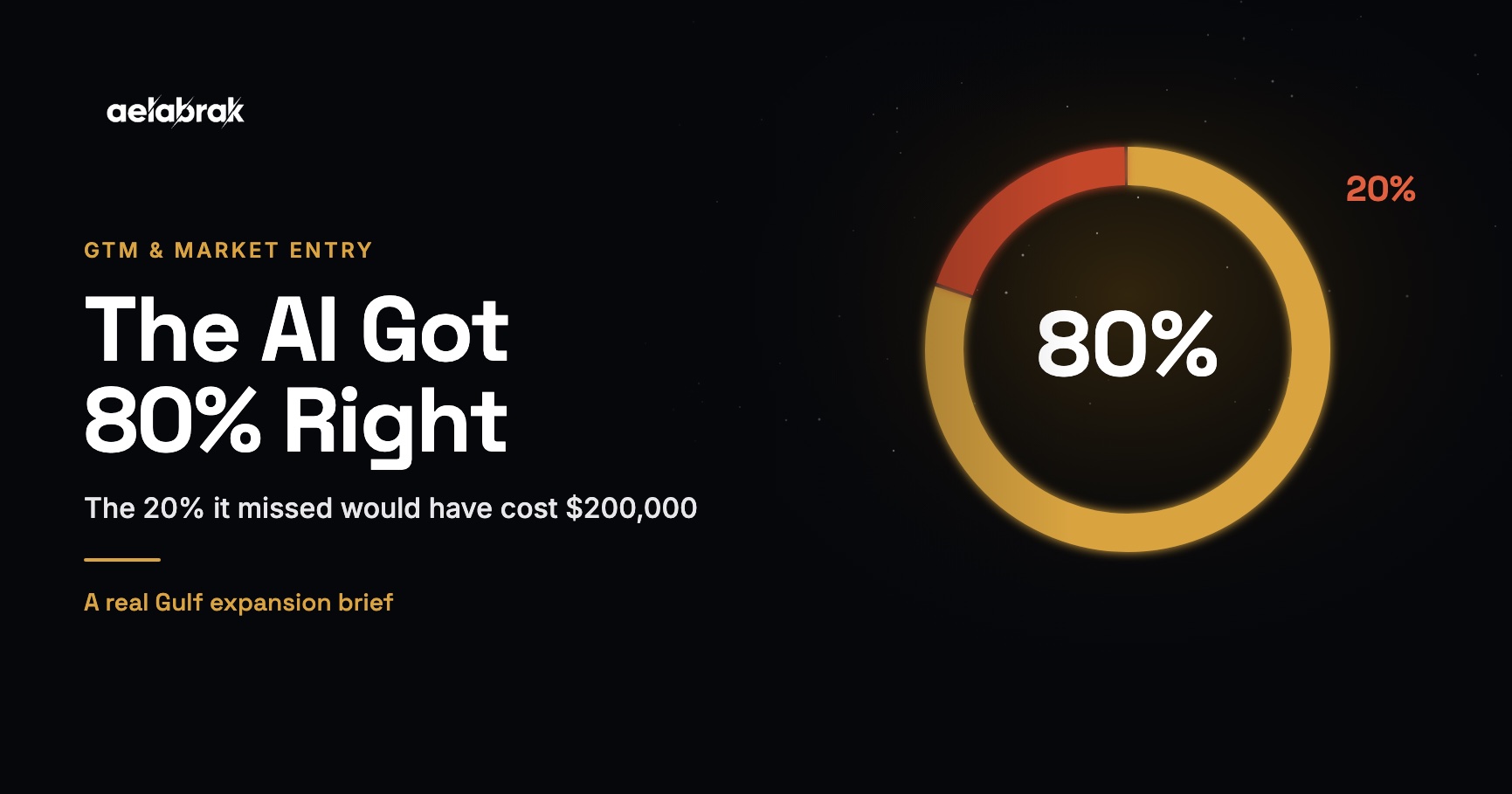
Last month, I ran an experiment. I took a real brief, the same kind I work through at the start of a Gulf market entry engagement, and handed it to an AI model. No modifications. No special prompting. Just the business context, the target market, and the goal.
The output was genuinely impressive.
And then I found the part that would have buried the company.
I’ve been building GTM strategies across UAE and KSA for 12+ years. When an AI system produces a Gulf expansion plan in 90 seconds, it deserves a fair evaluation, not a defensive one. Here is exactly what happened, what it got right, and why the 20% it missed represents the gap that still costs companies their first year in the market.
What I Actually Asked It to Do
The scenario: a European B2B SaaS company, 50-person team, wants to enter UAE. Their product is a compliance and document management platform. Primary buyers: procurement and compliance leads at large private companies and government-linked entities.
The Brief I Gave AI
| Company: European B2B SaaS, 50-person team |
| Product: Compliance and document management platform |
| Target buyers: Procurement and compliance leads at large private companies and government-linked entities in UAE |
| Request: Full Gulf GTM plan: entity structure, acquisition strategy, partner recommendations, timeline, 90-day priorities |
It produced a 12-page response in under 90 seconds.
What It Got Right
I’ll be direct: this output performed better than most first-pass market entry assessments I’ve reviewed from advisory firms charging five figures. For a founder doing their first pass of research, it would have saved 20 to 30 hours of reading.
Where AI Performed Well
| Free zone options with cost comparisons: DMCC, DIFC, and ADGM correctly identified and compared with accurate pricing ranges |
| Regulatory checklist: standard licensing requirements outlined without major gaps at the surface level |
| Market sizing: UAE enterprise software market estimates were credible and sourced |
| Competitor overview: a reasonable starting framework for understanding who else is in the space |
| Timeline benchmarks: setup timelines and typical deal cycle estimates were broadly accurate |
If you need to orient yourself quickly in a market you don’t know, AI is the best starting point available. The mistake is treating it as the endpoint.
The 20% That Would Have Cost $200,000
Here is where it went wrong. Precisely and expensively.
The AI recommended a DMCC free zone setup. For most B2B SaaS companies entering UAE, that is a defensible call. DMCC is well-established, cost-efficient, and operationally smooth. The AI had done its homework.
But it missed one thing: this company’s primary buyer profile included UAE federal government entities and Abu Dhabi-based semi-government organisations.
A DMCC free zone entity cannot bid on UAE federal government tenders. Under UAE federal procurement rules, vendors must hold a mainland commercial licence registered with Dubai Economy and Tourism (DET) to be eligible. A free zone entity is disqualified without a branch or additional mainland registration. UAE Ministry of Economy
The AI had no way of knowing this company’s pipeline would hit this restriction. It gave a technically sound answer to the wrong version of the question.
What Discovery-After-Setup Looks Like
| Free zone registration fees (already paid) | AED 25,000 to 35,000 |
| Annual flexi desk lease (contract signed) | AED 30,000 to 50,000 |
| Year-1 target contracts, unreachable with wrong licence | ~USD 200,000 |
| Total exposure | $260,000+ |
This is the gap that costs international companies their first year in the Gulf. Not the broad strokes. AI handles those well. It is the intersection of your specific business model, your specific buyer profile, and the UAE’s regulatory architecture that determines whether your setup decision is right. Getting that intersection right takes a practitioner who knows the market. This is precisely what I map in the International Market Entry advisory before you commit capital, not after.
What AI Does Not Have Access To
There is a second error in the plan, harder to quantify but commercially significant.
The AI recommended a direct outbound strategy to procurement and compliance leads: LinkedIn outreach, email sequences, direct introductions. The logic was sound: identify the buyer, reach them directly.
In UAE government-linked organisations, this is often how you end a conversation before it starts.
How Government-Adjacent Sales Actually Moves in the UAE
| What AI recommended: Direct LinkedIn outreach to procurement leads |
| What actually works: Warm introduction through a VAR, reseller, or partner with an existing account relationship |
| Why AI can't know this: The right contact is not on LinkedIn. The right partner is not in any database. This network is built over years of direct engagement in the market. |
I’ve spent 12+ years building this across UAE and KSA, working through 142+ engagements and securing 100+ strategic partnerships. AI has access to none of it. For more on how Gulf market entry actually gets done beyond the regulatory layer, this article covers what most plans miss.
How to Actually Use AI in a Gulf Market Entry
None of this means AI is the wrong tool. It means it is the wrong tool for the wrong part of the job.
| Use AI for the research layer | Use a human advisor for the decision layer |
|---|---|
| Market sizing and macro data | Licence structure for your specific buyer profile |
| Free zone options and cost comparisons | Which partners can actually open the right doors |
| Regulatory checklists at the surface level | Buyer channel strategy: who to approach and how |
| Competitor overview | Entry sequence and 90-day market priorities |
| Timeline benchmarks | Any decision where being wrong is expensive and slow to reverse |
The Rule
The companies that struggle in the Gulf are rarely the ones who skipped the research. They are the ones who treated the research as the plan.
Frequently Asked Questions
Can AI replace a human advisor for Gulf market entry?
Not for the decision layer. AI is effective for research, orientation, and framework building. Where it falls short is in the intersection of your specific business model, buyer profile, and the Gulf’s regulatory and commercial architecture. These decisions require practitioner knowledge and live market context that AI cannot access.
What did AI get wrong specifically about UAE business setup in this case?
It recommended a DMCC free zone setup without recognising that the company’s primary buyer profile, UAE federal government entities, requires a mainland DED licence structure. A free zone entity cannot bid on UAE federal government tenders without additional mainland registration. The cost of discovering this post-setup would have exceeded USD 200,000 in locked-out contracts, on top of sunk setup fees.
What does AI miss about Gulf sales strategy?
AI applies general B2B outbound logic: direct outreach to identified buyers via LinkedIn or email. In UAE and KSA, especially in government-adjacent and large enterprise accounts, access moves through relationship-driven channels: referrals, distributors, and partners with existing account relationships. This network is invisible to any AI system.
When should you use AI versus a Gulf market advisor?
Use AI to do your initial market scan and orient yourself in the market. Use a practitioner when you are making structural decisions: entity type, licensing, market entry sequence, and partner strategy. The cost of getting structural decisions wrong in the Gulf is high and often irreversible in the short term.
Does the same problem apply to entering KSA?
Yes, and in KSA the regulatory environment has changed significantly since Vision 2030 accelerated reforms. AI-generated plans often reflect older licensing requirements that have since been revised, or miss current MISA rules for specific foreign company structures. The principle is the same in both markets: the research layer versus the decision layer are two different jobs.
The Bottom Line
AI produced a plan. A competent, well-structured, 80%-right plan. That is genuinely useful as a starting point.
The 20% it missed was not a minor gap. It was the part that determines whether the first year in the Gulf works or doesn’t: licence structure, buyer channel, regulatory fit. These decisions are not complex once you know the market. You need to know the market to get them right.
That is still the job.
Ready to get the structural decisions right before you commit?
If you are planning to enter UAE or KSA and want to map the right structure, buyer channel, and entry sequence before committing capital, start here.
Or book the GCC Growth Diagnostic: a structured diagnostic that maps your Gulf entry plan and finds what AI would have missed.
Anas El-Abrak, GTM & Growth Partner, UAE and KSA
Questions I get asked
Can AI replace a human advisor for Gulf market entry?
Not for the decision layer. AI is effective for research, orientation, and framework building. Where it falls short is in the intersection of your specific business model, buyer profile, and the Gulf's regulatory and commercial architecture. These decisions require practitioner knowledge and live market context that AI cannot access.
What did AI get wrong specifically about UAE business setup?
It recommended a DMCC free zone setup without recognising that the company's primary buyer profile required a mainland DED licence structure. A free zone entity cannot bid on UAE federal government tenders without additional mainland registration. The cost of discovering this post-setup would have exceeded USD 200,000 in locked-out contracts.
What does AI miss about Gulf sales strategy?
AI applies general B2B outbound logic: direct outreach to identified buyers via LinkedIn or email. In UAE and KSA, especially in government-adjacent and large enterprise accounts, access moves through relationship-driven channels: referrals, distributors, and partners with existing account relationships. This network is invisible to any AI system.
When should you use AI versus a Gulf market advisor?
Use AI to do your initial market scan and orient yourself in the market. Use a practitioner when you are making structural decisions: entity type, licensing, market entry sequence, and partner strategy. The cost of getting structural decisions wrong in the Gulf is high and often irreversible in the short term.
Does the same problem apply to entering KSA?
Yes, and in KSA the regulatory environment has changed significantly since Vision 2030 accelerated reforms. AI-generated plans often reflect older licensing requirements that have since been revised, or miss current MISA rules for specific foreign company structures.
Get new articles in your inbox.
Gulf Business Weekly: one short email a week from inside the market. No filler, no pitches.